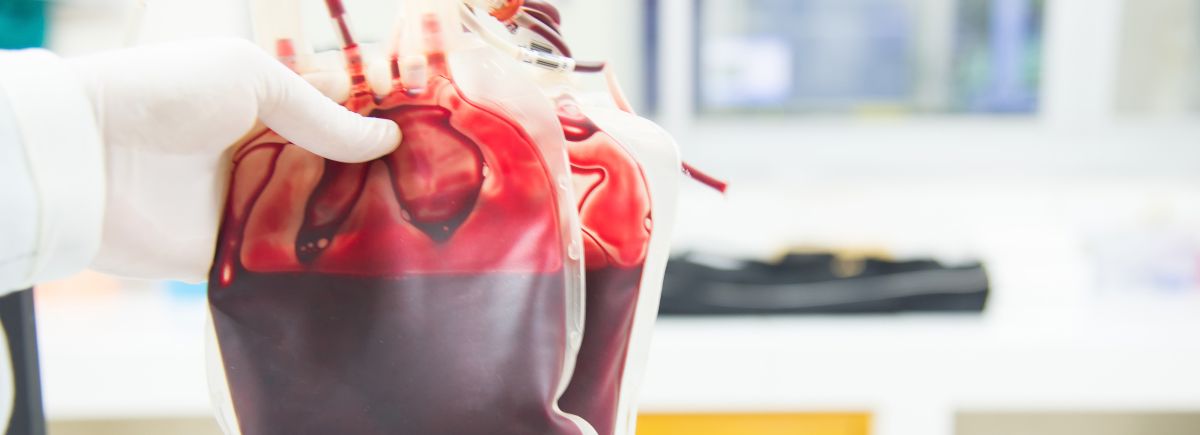
Plasticized PVC (PVC-P) is the benchmark material for blood and blood-component bags: no other polymer matches its balance of flexibility, optical clarity and biocompatibility built on decades of clinical use. In an application with virtually zero tolerance for defects, where a thickness deviation or a micro-bubble in the film is a patient-safety issue, the conversion process carries as much weight as the compound formulation itself.
A compound built around biocompatibility
Medical-grade PVC-P is never processed as a neat resin. The compound typically combines a higher K-value resin (around 70) with 30 to 40% plasticizer by weight, chosen to balance permanent flexibility with the mechanical integrity required through filling, centrifugation and cold storage. DEHP has been the industry's default plasticizer for decades, valued for stabilizing the red blood cell membrane during storage, reducing hemolysis. Its classification as a CMR substance under REACH, together with the substance-justification requirements of the EU Medical Device Regulation (2017/745), is now driving formulators toward TOTM and DINCH for standard bags, and BTHC for the higher-gas-permeability grades used in platelet storage, where aerobic metabolism demands continuous oxygen and CO2 exchange. Calcium-zinc stabilizers complete the formulation, avoiding heavy metals incompatible with blood contact, while optical clarity, essential for visual inspection before transfusion, remains a non-negotiable processing target throughout.
Calendering: where thickness tolerance becomes a safety parameter
BG Plast (Marnate, Italy) builds calender lines with independently motorized rolls, each on its own thermoregulation circuit controlling oil or water flow to hold roll temperature within a narrow band across the full film width. In plasticized PVC, even a small thermal mismatch between rolls shows up as thickness variation – that could compromise both RF-weld strength and the optical clarity needed for visual blood inspection. For the thin gauges typical of medical film (up to 850 micron), a cross-axis device shifts the lower roll axis relative to the central one, giving finer thickness control than a fixed-geometry calender can achieve.
Multilayer coextrusion for the DEHP-free transition
As the industry phases out DEHP, manufacturers increasingly turn to multilayer structures: a blood-contact inner layer formulated for biocompatibility, paired with outer layers engineered for weldability and mechanical performance. Through a range of feedblock configurations, BG Plast calender lines support coextrusion set-ups of up to seven extruders, letting converters evolve their film architecture without a full line replacement.
"Anyone processing medical PVC knows that a tenth of a degree or a micron of tolerance carries different weight than in other applications. This isn't about a production reject, but the safety of whoever receives that bag," says Florio Roccon, founder of BG Plast.
About BG Plast
Founded in 1987 in Marnate, near Varese, Italy, BG Plast designs and builds special extrusion and calendering plants for thermoplastic sheet and foils, serving sectors from pharmaceutical and medical packaging to construction, automotive and civil-engineering geomembranes. More information: www.bgplast.it