A growing application
With the expansion of energy, water and fiber-optic networks, the demand for reliable protection systems for underground grids is rising. Utility warning plates - also known as cable protection covers or warning boards - are currently one of the most interesting applications in the extrusion of technical thermoplastic sheets.
Function and standardization
The product serves a dual purpose: it visually signals the presence of the utility before the excavator bucket reaches the cable or pipe, and it absorbs the mechanical impact to protect it. Colors comply with the EN 12613 standard – yellow for gas, blue for water, red for electricity and green or orange for telecommunications. Furthermore, the plate can incorporate metallic tracer tapes for trenchless electromagnetic location.
Materials: comparing HDPE, PP and PVC
The most widely used materials are HDPE, PP and PVC. HDPE dominates the market due to its excellent balance of mechanical strength, lightweight property and chemical inertness, offering an underground lifespan of up to 30–50 years. PP provides higher stiffness for the same thickness and is well-suited for multilayer co-extrusion. PVC remains competitive where structural rigidity is a priority and costs must be kept low.
BG Plast lines for HDPE and PP sheets
Founded in 1987 and based in Marnate (Varese), BG Plast designs extrusion lines for thermoplastic sheets using a custom-tailored technical approach. For HDPE plates, configurations reach useful widths of up to 8,000 mm and production outputs up to 2,000 kg/h.
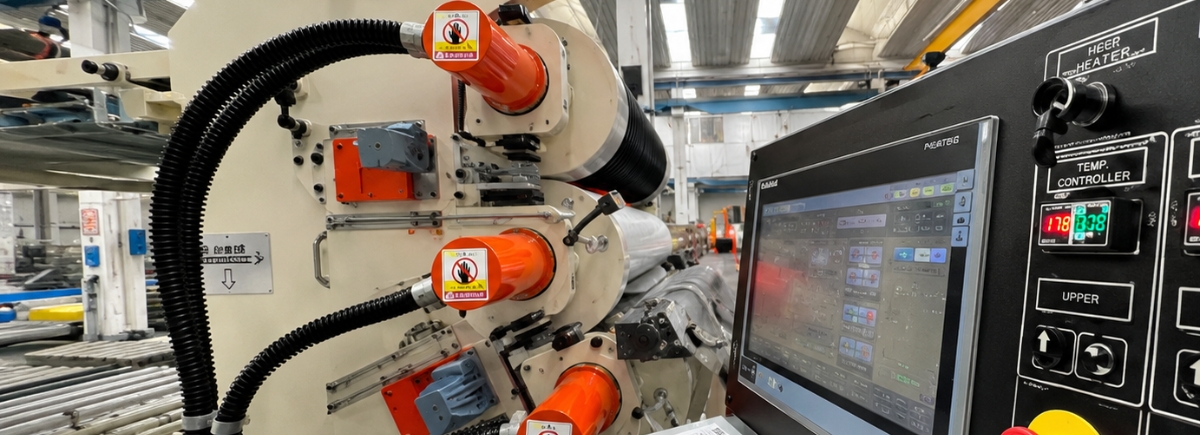
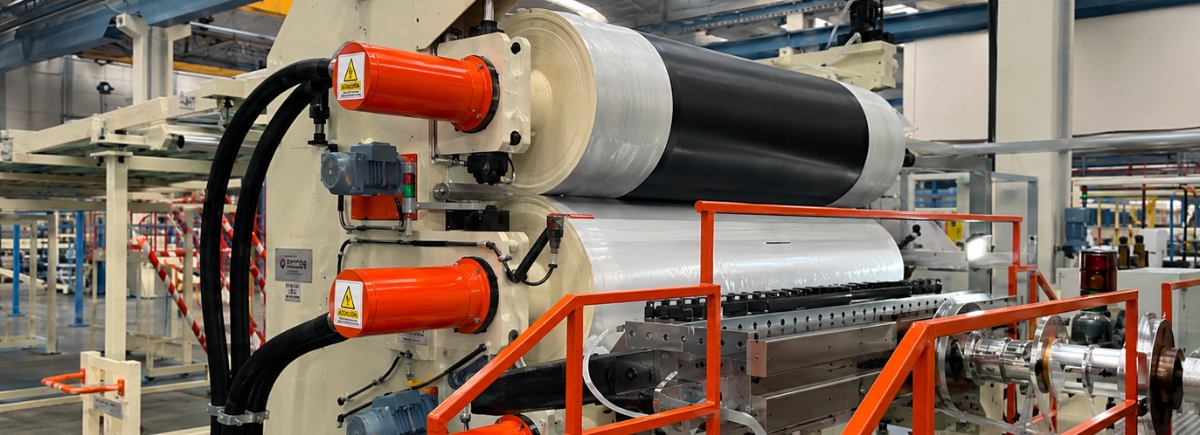
The core of this technology is the in-house developed calender. It features precision electromechanical control over roll opening, independent temperature regulation for each roll, and manageable thicknesses ranging from 0.1 to 40 mm. For specialized production, patterned rolls are available to provide the sheet with stiffening ribs, anti-shock surfaces and impact-absorbing profiles directly in-line. The TM series single-screw extruder (from TM35 to TM200, L/D up to 44) completes the system. It features a screw and barrel made of special steels – 41 CrAlMo7 and 38 CrAlMo7 – with a hard bi-metallic coating available for abrasive materials or high concentrations of pigmented masterbatches.
"Even seemingly simple products like utility protection plates require extremely precise control over the production process," explains Florio Roccon, owner of BG Plast. "The goal is not just to manufacture a plate, but to guarantee consistent performance and reliability throughout the infrastructure's life cycle. This is why every line is configured based on the final product specifications," Roccon continues. "Width, thickness, polymer, co-extrusion: we optimize every variable for maximum productivity and quality."
In a market increasingly focused on safety, sustainability and infrastructure durability, extrusion technologies are undoubtedly a strategic element for developing the networks of the future.