When manufacturers experience vibration, misalignment, premature pulley wear or excessive production scrap in positive drive conveyor belts, the first suspect is often the material compound. According to BG Plast, however, the root cause frequently lies elsewhere: in the design and stability of the extrusion process itself.
The Italian company, headquartered in Marnate and specialized in the engineering of extrusion and calendering lines for thermoplastic materials, has developed significant expertise in this field through projects dedicated to the production of TPU belts used in automated logistics and vertical conveying systems.
Positive drive belts operate in demanding environments such as automated warehouses, robotic lines and multi-level storage systems, where even small dimensional variations can compromise synchronization with the pulleys. In these applications, the belt cannot slip, elongate under load or lose tooth pitch.
“Many manufacturers focus on the compound formulation when problems appear,” explains Florio Roccon, owner of BG Plast. “But in our experience, the real difference is often made upstream, by the stability and precision of the extrusion and calendering line.”
Process stability starts before extrusion
Thermoplastic polyurethane (TPU) has become the reference material for these applications thanks to its elasticity, abrasion resistance and chemical stability. However, it also requires extremely careful process control.
Because TPU is hygroscopic, the preparation phase before extrusion is crucial. Proper drying and conditioning units are necessary to remove residual moisture and stabilize the material before it enters the extruder. Without this step, the process can become unstable, leading to rheological fluctuations, surface defects and dimensional inconsistency.
Once in the extrusion stage, further variables come into play: screw design, temperature control and pressure stability. BG Plast systems integrate multi-zone thermal management and melt pumps to ensure consistent flow and avoid thickness fluctuations along the belt.
Calendering precision for accurate tooth geometry
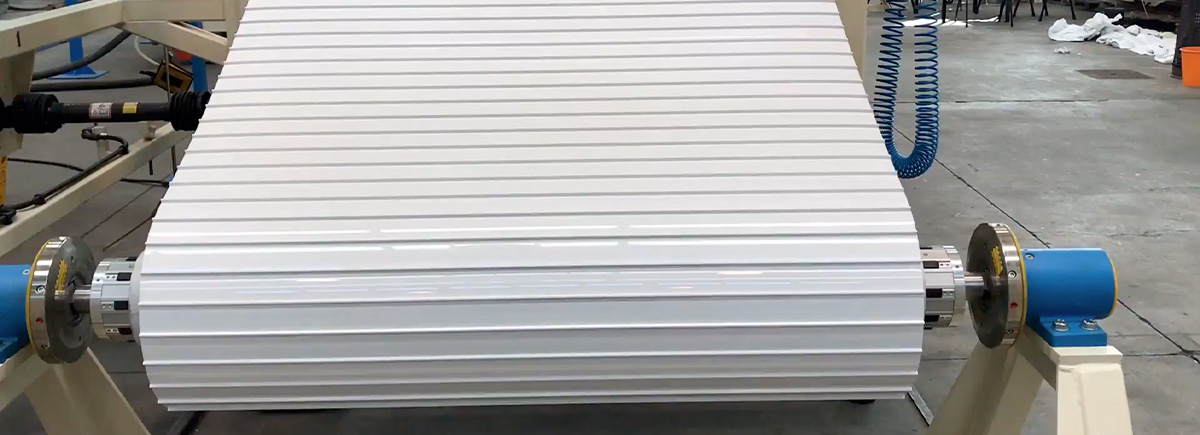
For positive drive belts, extrusion alone is not sufficient. The tooth profile must be formed with extreme accuracy through the calendering process. Even minimal deviations in pitch can accumulate over long lengths, causing mechanical engagement issues between belt and pulley.
BG Plast designs extrusion and calendering lines as a single integrated system in which the extruder, die and calender operate in dynamic balance.
“In these applications, we are not just supplying a machine,” Roccon adds. “We are engineering a process capable of maintaining geometric accuracy and dimensional stability over tens of meters of product.”
Engineering the belt before it exists
From reinforcement integration to in-line laser measurement systems that reduce scrap by up to 20%, process design becomes a key factor.
Founded in 1987, BG Plast has built its reputation on customized extrusion solutions for films, sheets and technical thermoplastic products across multiple industries. For the company, the message is clear: the performance of a conveyor belt is determined long before installation, starting with the design of the extrusion line that produces it.
“In industrial automation, reliability is everything,” Roccon concludes. “If a belt stops, the entire system stops. That’s why efficiency must start with the process.”