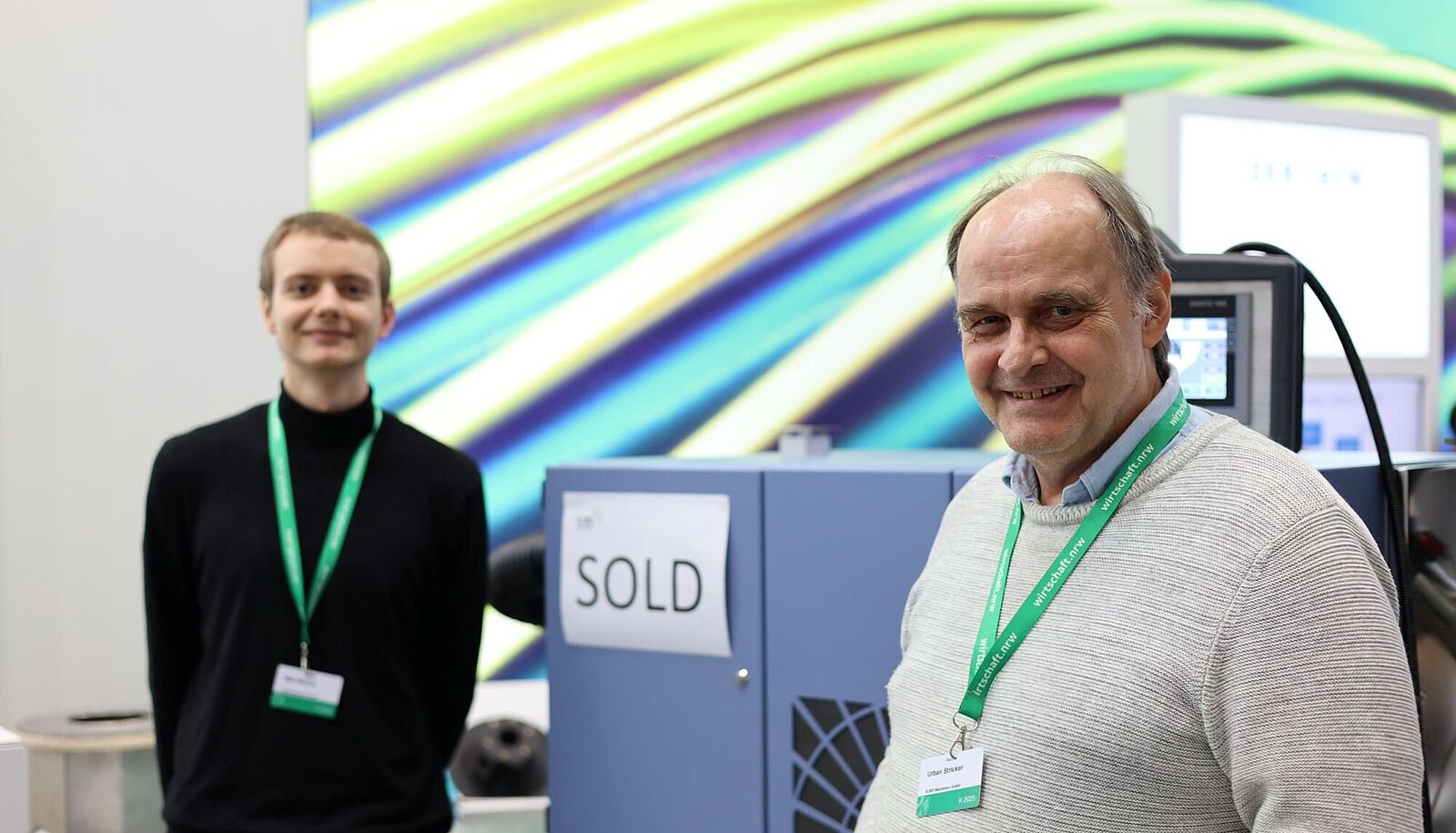
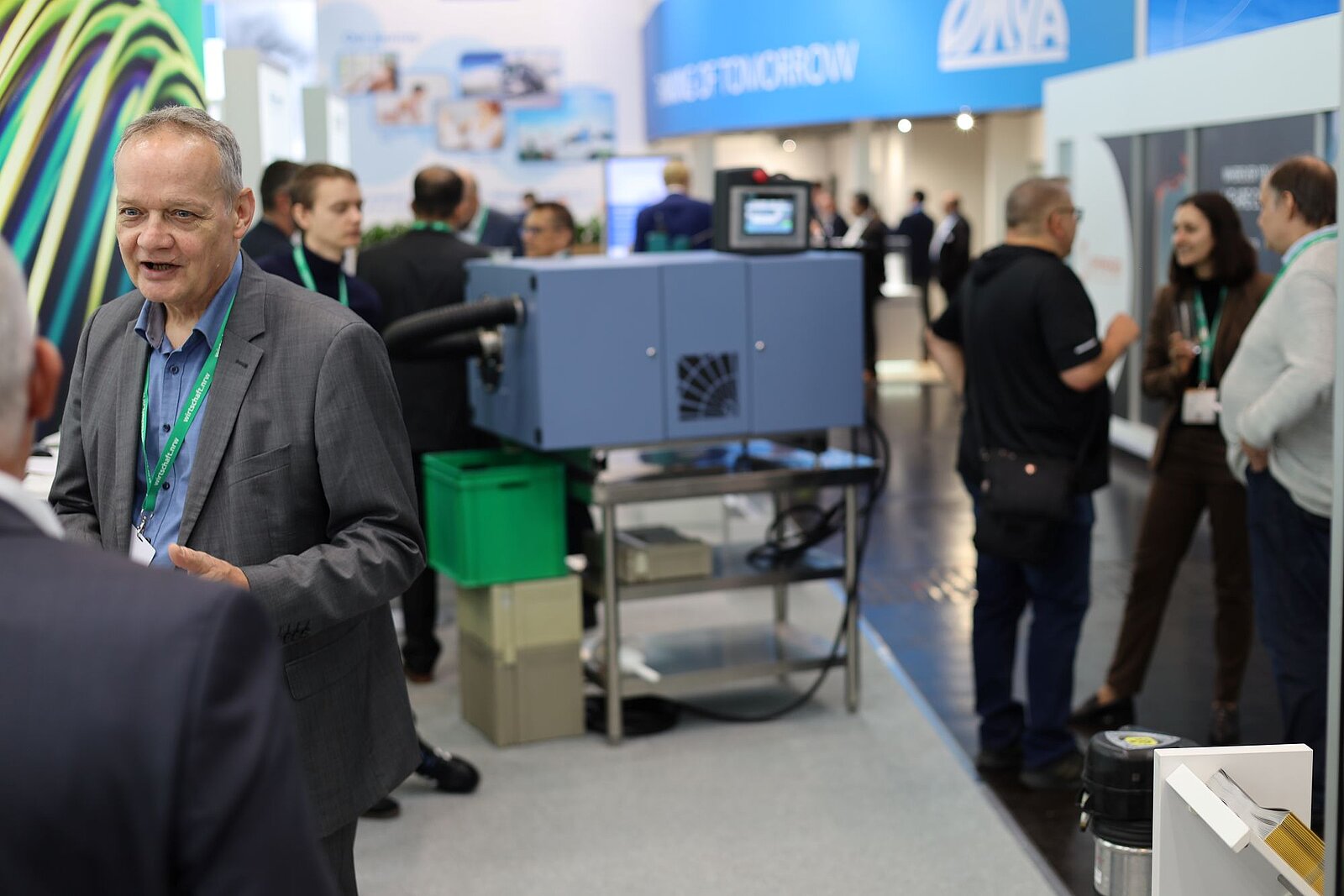
Companies in the plastics-processing industry must make their operations more efficient, avoid material losses and, at the same time, reduce energy consumption. At K 2025, it became clear which concepts can support these efforts. Many trade visitors had B.IRD Machinery Stricker GmbH’s infrared solution firmly on their agenda. They came specifically to the stand of the family-owned company from Aachen to learn more about its infrared rotary-drum technology. Demand was so strong that several machines were sold directly at the fair.
B.IRD uses infrared radiation to dry plastics rapidly, energy-efficiently and with minimal material stress. In contrast to conventional hot-air drying, infrared does not merely heat the surface; the energy penetrates deep into the material, acting directly at the molecular level. Part of the physical explanation for the process’s high efficiency lies in the so-called photomolecular effect.
Water Must Go – And Infrared Is Ideal for the Task
Urban Stricker, Technical Director and Co-Founder of B.IRD, explains the physical principles: “Ultimately, the aim is to remove water molecules from a polymer matrix as efficiently as possible. We are not aware of any technology that does this better than our infrared irradiation. Compared with hot-air drying, users save enormous amounts of time and energy while treating their valuable materials more gently, as infrared heating is inherently less aggressive.
We now know that the photomolecular effect—only recently demonstrated scientifically—also plays a role in our technology. In addition to ordinary heat-driven evaporation, certain photons striking the material contribute to breaking hydrogen bonds even without thermal influence. This increases the mobility of water molecules, significantly accelerating the drying process. Of course, you can loosen a screw with a kitchen knife—but a cordless screwdriver does the job far better.”
The technology also shows its potential in injection moulding.
“We have optimised the infrared rotary-drum drying principle for lower throughput volumes. This means that injection moulding can now benefit from the technology as well. For materials such as PA, PC, PMMA or ABS, suitable series-production machines are available. Depending on the material type, drying times range from three to thirty minutes. This opens up new possibilities for efficient, process-stable production, even for smaller batch sizes,” says Urban Stricker.
For users, the advantages are clear: markedly shorter drying times, reduced energy consumption and, above all, consistently high material quality. As heated granulate is guided through a cool process chamber, the method is also independent of changing ambient conditions. Thanks to precise control, a compact footprint and quiet operation, the system integrates seamlessly into existing processes.
Technology as a Competitive Advantage
B.IRD’s infrared rotary-drum technology offers substantial economic benefits. Co-Founder Daniel Stricker, brother of Urban and Chief Commercial Officer, sees a clear trajectory:
“Viewed clearly, this is a technology for dramatically improving efficiency. Particularly in difficult times, it helps companies strengthen their competitive position. This is more than an added benefit—it is a strategically important advantage. It is therefore unsurprising that plastics processors and recyclers increasingly regard B.IRD as a highly valuable option. Our first production series is sold out. We are launching the next production cycle and will deliver the next units in spring 2026.”
Family, Experience and a Forward-Looking Approach
B.IRD was founded in February 2020 by brothers Daniel and Urban Stricker, who together bring more than 80 years of experience in plastics engineering. Two years after the company’s founding, the first prototype was created. In 2025, with the start of series production and strong market success at K, the commercial breakthrough followed. B.IRD is a family-owned business with a long-term mindset—a fact also reflected in the involvement of the next generation. Industrial engineer Mati Stricker, Daniel’s son, already works at the company.
“I am fascinated by the combination of technological development and direct customer benefit,” says Mati Stricker. “B.IRD offers an environment where I can genuinely make an impact. And our location in Aachen gives us a decisive advantage. The proximity to the IKV provides access to world-leading expertise in plastics engineering—a resource of immense value, especially during development.”
Flight Plan for the Future Ready
The response at K 2025 was far more than a respectable success for B.IRD; it marked the transition from development to widespread application. High demand, sold-out production capacity and growing waiting lists demonstrate the industry’s need for economically viable technologies in plastics processing.
B.IRD shows that innovation and efficiency are not opposites but mutually reinforcing forces. Its infrared rotary-drum technology sets new standards in drying: fast, precise, energy-saving and reliable. The family-owned company from Aachen exemplifies the transformation currently reshaping the industry. It demonstrates that technical progress is possible even in challenging times—provided it is driven by experience, conviction and customer focus.
About B.IRD Machinery
B.IRD Machinery Stricker GmbH was founded in Aachen in February 2020 by brothers Dipl.-Ing. Urban Stricker and Daniel Stricker, both industry veterans. Since the 1990s, Urban Stricker has developed infrared rotary drum (IRD) technology for heating and drying bulk solids, successfully adopted by licensees in hundreds of extrusion installations worldwide. B.IRD Machinery develops and produces the next generation of this technology for smaller batch sizes, typical in injection moulding. Following a prototype debut at K 2022, the company launched its first series units, the “B.IRD 5,” at the end of 2024. In practical use, B.IRD’s infrared rotary drums have repeatedly exceeded expectations.
The brothers also see strong potential for the technology to improve other processes that demand fast, energy-efficient, and gentle drying and preheating.